
The Woman You Are Now
Why Personal Style Begins With an Honest Look at Your Present Life
Sometimes the problem isn’t that we don’t know how to dress; it’s that we’re still dressing for a woman we no longer are.
Our lives change gradually. Careers evolve. Bodies change. Relationships begin and end. Children grow up. Priorities shift. We move homes, discover new interests, become more confident, simplify our lives, or simply begin to see ourselves differently.
And yet our wardrobes don’t always evolve at the same pace.
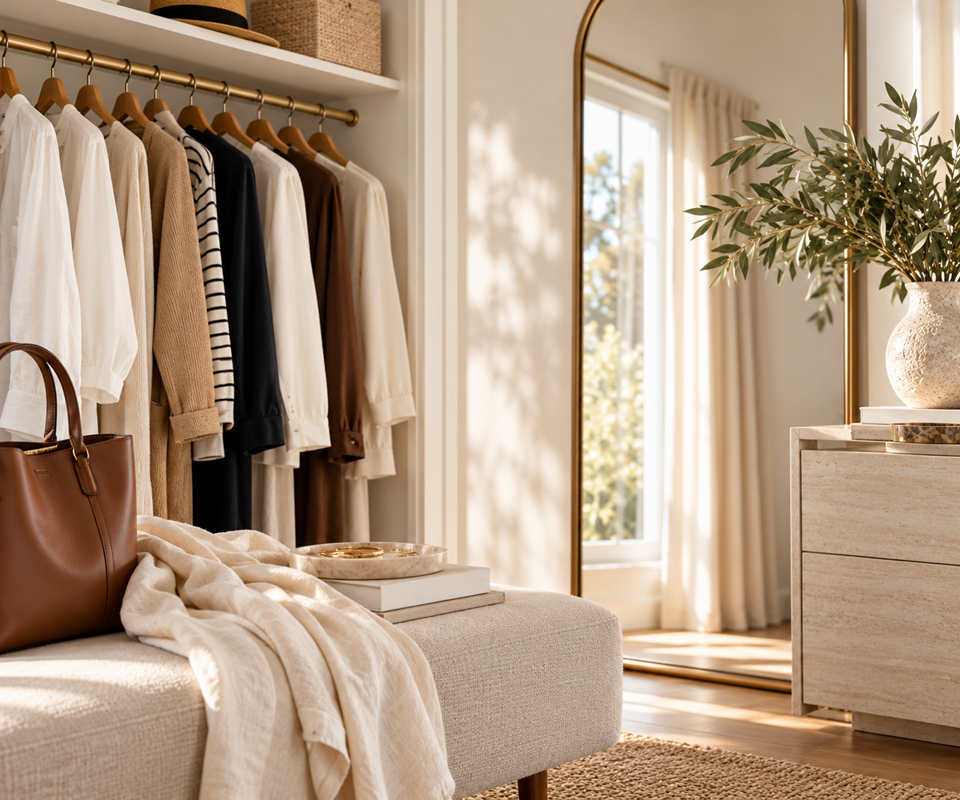
Open your wardrobe and you may find pieces belonging to several different versions of yourself.
- The woman who worked in a corporate office five days a week.
- The woman who went out every weekend.
- The woman who wore a different size.
- The woman who thought she should dress a certain way.
- The woman who bought clothes for a life she imagined she might one day have.
And somewhere amongst all of them is the woman you are now.
Perhaps she deserves a little more attention.
Our Wardrobes Hold More Than Clothes
Clothes can be surprisingly emotional objects.
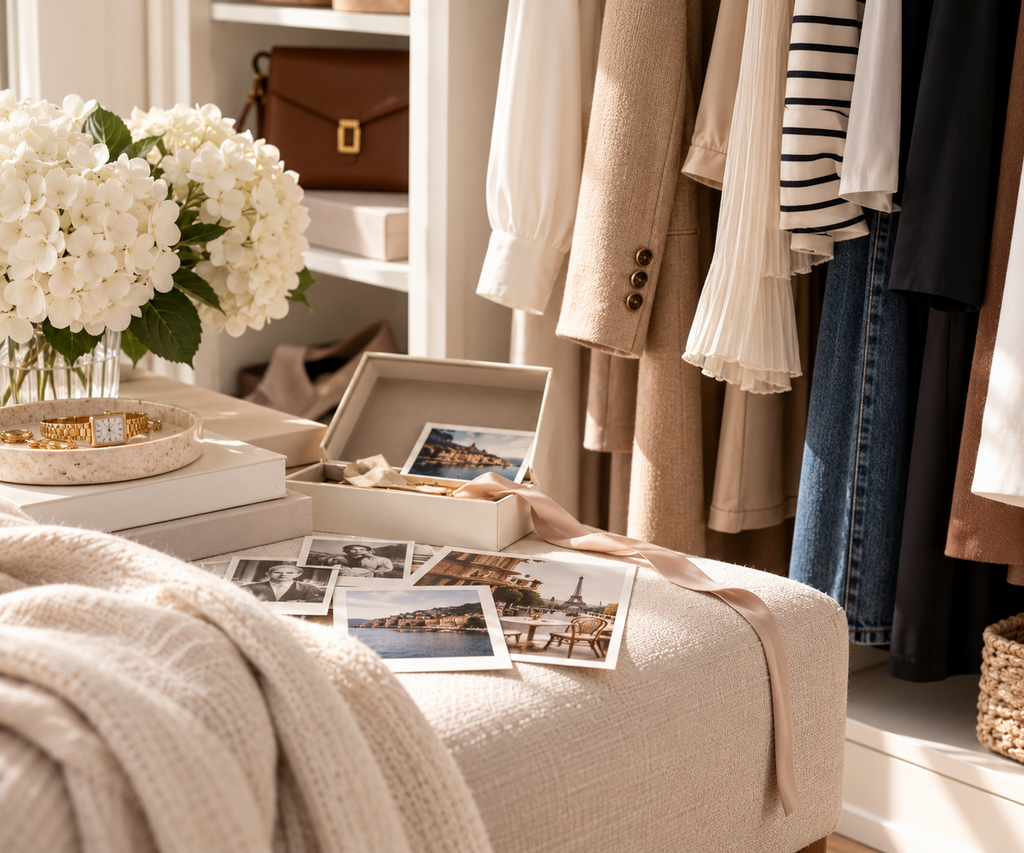
A dress isn’t always just a dress. It might remind us of a particular period in our lives. A jacket may represent a career we worked hard to build. A pair of jeans might remind us of a body we once had. Something expensive may stay in the wardrobe simply because admitting we no longer wear it feels wasteful.
Sometimes we keep clothes because we love the memories attached to them, and sometimes we keep them because letting go feels like admitting that something has changed.
But change is not necessarily loss; it is simply evidence that we are living.
Personal style isn’t meant to preserve us at one particular moment in time. It should have enough flexibility to evolve alongside us.
The Wardrobe Time Lag
There is often a gap between the life we’re living and the wardrobe we’ve accumulated.
I think of it as a kind of wardrobe time lag. Our circumstances change, but our clothes remain.
- Perhaps your working life has become more casual, yet half your wardrobe is still filled with corporate clothing.
- Perhaps you once loved high heels but now reach almost exclusively for flats.
- Perhaps you spent years buying clothes for occasions and now realise what you actually need are beautiful everyday pieces.
- Or perhaps your taste has simply changed.
There doesn’t need to be a dramatic reason; sometimes we just grow out of things without physically growing out of them.
And that can be harder to recognise.
When “It Still Fits” Isn’t Enough
One of the easiest reasons to keep something is, “It still fits.”
But physical fit is only one kind of fit.
- Does it fit your lifestyle?
- Does it fit your personal style?
- Does it fit the way you want to present yourself?
- Does it fit the woman you have become?
A garment can fit your body perfectly and still feel completely wrong.
We’ve probably all experienced it. You put something on, look in the mirror and technically there is nothing wrong with it. But, somehow it doesn’t feel like you anymore.
That feeling is worth paying attention to.
Style is not only about whether clothing fits our measurements. It is also about whether it feels aligned with our identity.
Dressing for a Former Body
Our relationship with clothing can become particularly complicated when our bodies change.
It can be tempting to keep an entire wardrobe waiting for the day we return to a previous size or shape.
A few pieces may be sentimental or worth keeping. But a wardrobe dominated by clothes that don’t fit the body you live in today can quietly turn getting dressed into a daily judgement.
Your wardrobe should support you now.
- Not after five kilograms.
- Not after a new exercise routine.
- Not when you finally become disciplined enough.
Now.
That doesn’t mean abandoning health goals or pretending our bodies never change. It simply means recognising that the body getting dressed this morning deserves clothes that fit comfortably and make you feel good today.
There is something deeply respectful about that.
Dressing for an Imaginary Life
There is another woman who often occupies a surprising amount of wardrobe space.
Our fantasy self.
- She attends more cocktail parties.
- She wears beautiful linen while wandering through European villages.
- She somehow has endless opportunities to wear dramatic dresses.
- She may even have an entirely different personality.
There is nothing wrong with aspiration. Clothes can be wonderful tools for exploring who we are becoming.
But there is a difference between dressing towards the person you want to become and continually shopping for a life you don’t actually live.
One expands your identity, and the other fills your wardrobe.
The distinction is worth noticing.
Look at What You Actually Wear
One of the simplest ways to understand your current style is to stop looking at what you own and start looking at what you wear.
This matters.
Most of us have far more clothes than our regular rotation suggests.
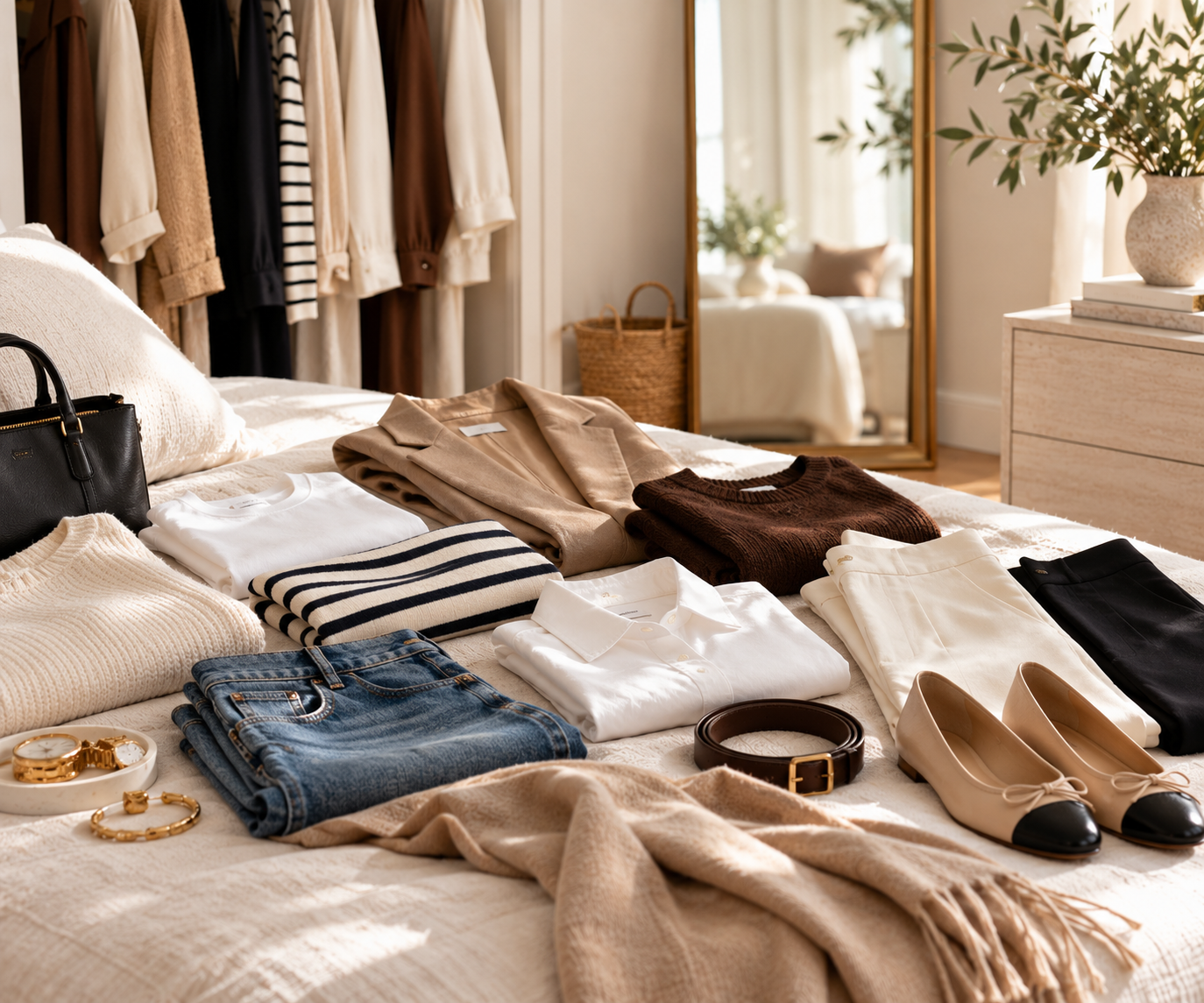
There are pieces we instinctively reach for again and again. The trousers that always feel right. The jacket that somehow works with everything. The shoes we choose when we want to feel polished. The colours that make us feel most like ourselves.
These repeated choices contain useful information.
- They tell us about comfort.
- They tell us about proportion.
- They tell us about colour.
- They tell us about the reality of our lifestyle.
And, perhaps most importantly, they tell us about who we are when nobody else is making the decision for us.
Your most-worn clothes may tell you more about your personal style than anything sitting on a Pinterest board.
You Don’t Owe Your Former Self a Wardrobe
There can be a strange sense of loyalty attached to our previous identities.
- We may feel we should still love something because we once loved it.
- We may keep wearing a particular style because people associate us with it.
- We may resist changing our appearance because it feels frivolous, unnecessary or somehow disloyal to the person we have always been.
But personal style isn’t a uniform you select once and wear forever. It is allowed to change.
- You are allowed to prefer different colours.
- You are allowed to stop wearing heels.
- You are allowed to become more minimal.
- You are allowed to become less minimal.
- You are allowed to discover that the clothes you thought represented you, no longer do.
Changing your mind is not inconsistency, sometimes it is simply self-knowledge catching up.
Start With the Life You Already Have
Before thinking about what your wardrobe needs, look at your life.
Not the idealised version; the real one.
- Where do you spend your time?
- What do you genuinely enjoy doing?
- What situations do you dress for most often?
- Which clothes make those situations easier?
- Which clothes make you feel comfortable, capable and like yourself?
- Where does your wardrobe seem to belong to another life entirely?
This kind of reflection can be far more useful than starting with a list of wardrobe essentials.
Because there is no universal list of clothes every woman needs.
There is only the wardrobe that supports your life.
The Woman in Front of the Mirror
Perhaps one of the kindest things we can do when we get dressed is stop comparing the woman in the mirror with previous versions of ourselves.
- She has lived more.
- She knows more.
- Her priorities may have changed.
- Her body may have changed.
- Her taste may have changed.
- She may be quieter than she once was. Or bolder. More discerning. Less interested in impressing people. More willing to invest in quality. More comfortable saying no.
Those changes deserve to be reflected in the way she presents herself to the world.
Personal style begins with seeing that woman clearly.
Not correcting her or trying to return her to an earlier version.
Simply recognising her.
Before we ask what we should wear next, perhaps there is a more important question, “Who am I dressing now?”
Once we can answer that question honestly, another question naturally follows, “What do I actually like?”
That is where we begin to develop something far more interesting than a fashionable wardrobe.
We begin to develop our own point of view.
Personal style isn’t meant to preserve us at one particular moment in time. It should have enough flexibility to evolve alongside us.