
Becoming the Curator of Your Own Life
Choosing What Deserves a Place in Your Wardrobe, Home and Attention
A curator does not choose everything.
She chooses what belongs, and considers quality, meaning, context and relationship.
She understands that something can be beautiful and still not belong in the collection.
And, perhaps most importantly, she understands that what is left out matters just as much as what is included.
What if we approached our own lives in the same way?
Not as projects requiring constant improvement, or empty spaces waiting to be filled, but as collections we are consciously creating.
- Our clothes.
- Our homes.
- Our possessions.
- Our routines.
- Our experiences.
- Our attention.
Perhaps intentional living is, at its heart, an act of curation.
A Life Is Built Through Selection
We tend to think about creating a life in terms of addition.
- What should I buy?
- Where should I go?
- What should I achieve?
- What should I learn?
- What should I do next?
But every addition carries a cost, but not necessarily a financial one. Everything we bring into our lives requires something from us.
- Possessions require space and care.
- Commitments require time.
- Relationships require attention.
- Clothes require storage.
- Information requires mental capacity.
Even beautiful opportunities require us to say no to something else.
We cannot include everything, so perhaps the more useful question isn’t, “What else can I add?”
It is, “What deserves to remain?”
Your Wardrobe Is Already a Collection
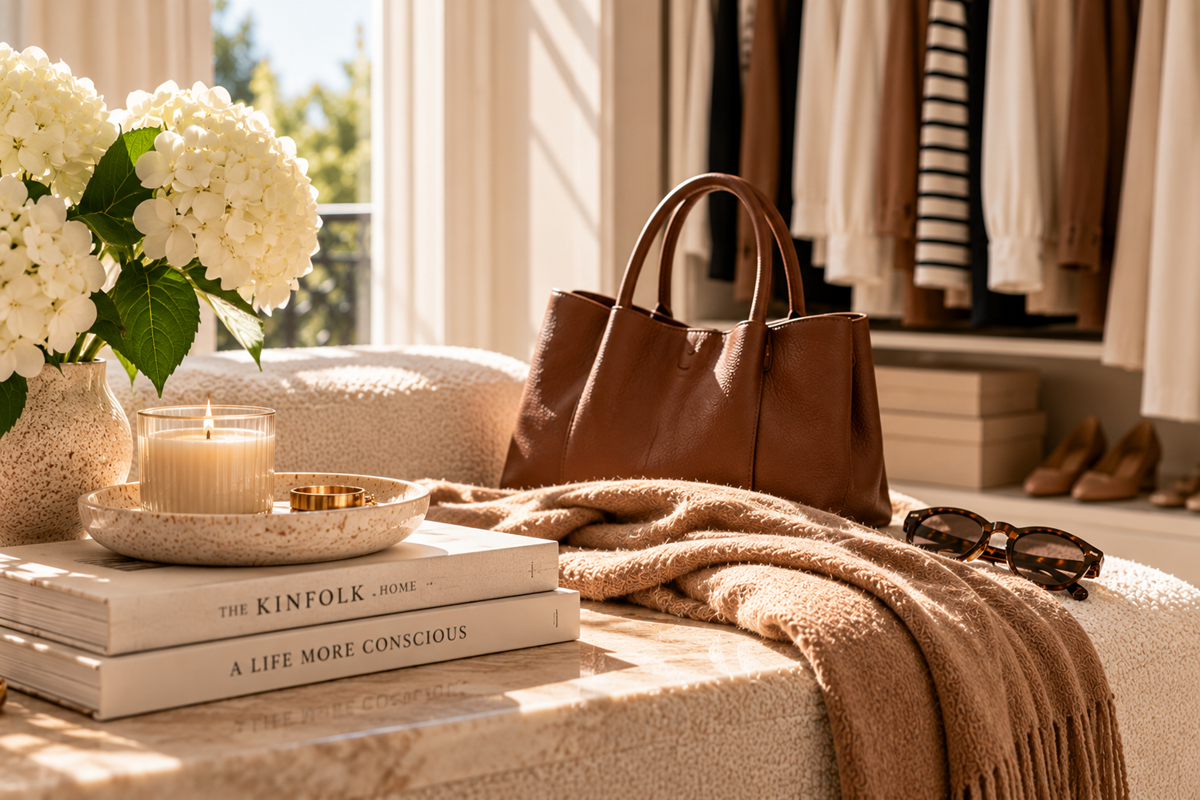
Think about your wardrobe as a collection rather than a storage space.
Immediately, the standard changes.
A collection has a point of view; there are relationships between the pieces.
- Some are practical.
- Some are beautiful.
- Some carry memories.
- Some are used constantly.
- Some may be worn rarely but still deserve their place.
What matters is that they belong.
This doesn’t mean creating a perfectly coordinated wardrobe where every garment matches every other garment, and nor does it mean reducing your wardrobe to an arbitrary number. It means becoming more conscious of why something is there.
- Does it support your life?
- Does it reflect your taste?
- Do you enjoy wearing it?
- Does it serve a purpose?
- Does it mean something to you?
There are many valid reasons for keeping something. Habit isn’t necessarily one of them.
Editing Is Part of Creating
We often think of editing as subtraction, but editing is also creative.
- A writer removes unnecessary words, so the important ones become clearer.
- A designer removes elements that distract from the whole.
- A curator leaves works out of an exhibition so those included can speak more powerfully.
The same principle applies to our lives. Removing something doesn’t always create emptiness; sometimes it creates emphasis.
Editing helps us see what matters.
Keep What Tells Your Story
Not everything in our lives needs to be practical.
Some things deserve their place because of the stories they hold.
- A piece of jewellery inherited from someone you love.
- A painting created by a friend.
- A souvenir from a place that changed you.
- A piece of furniture found second-hand years ago.
- A book filled with notes in the margins.
- A dress worn for an important occasion.
These objects may not satisfy conventional ideas about minimalism or utility, and that doesn’t matter.
A curated life isn’t a sparse life; it’s a meaningful one.
The goal isn’t to own as little as possible; it is to understand why we keep what we keep.
There is a significant difference.
Let Beauty Be Useful
We have a curious habit of protecting our most beautiful possessions from our everyday lives.
- The good china waits for guests.
- The beautiful dress waits for an occasion.
- The expensive handbag stays in its dust bag.
- The special candle remains unlit.
- The lovely notebook remains untouched because our handwriting might spoil it.
We save beauty for later, but later is an unreliable appointment.
If something deserves a place in your life because it brings you pleasure, perhaps it should be allowed to do its job.
A beautiful life isn’t created by owning beautiful things, it is created by experiencing them.
Curate Your Inputs Too
Not everything we consume occupies physical space.
Some of the most influential things entering our lives arrive through a screen.
- Images.
- Opinions.
- Advertising.
- News.
- Advice.
- Trends.
- Other people’s lives.
We absorb an extraordinary amount of information every day, often without consciously choosing it. And, just as an overcrowded wardrobe can make it difficult to see what we own, an overcrowded mind can make it difficult to hear our own thoughts.
Attention is one of the most valuable things we possess, yet we often give it away more casually than we spend money.
Perhaps attention deserves curation too.
Leave Room for Discovery
There is a danger in becoming too committed to the idea of curation.
We could turn our preferences into rules, and become so certain about what belongs that nothing unexpected is allowed in. But a good collection continues to evolve.
So should a life.
We should leave room for curiosity.
- A colour we never thought we would wear.
- A book outside our usual interests.
- An exhibition we know nothing about.
- A place we hadn’t planned to visit.
- A conversation with someone whose life looks nothing like ours.
- A piece of clothing that somehow breaks all our usual rules and still feels completely right.
Knowing yourself shouldn’t make your world smaller; it should give you a strong enough foundation to explore it.
Choose Slowly
There is something powerful about allowing decisions to take time.
Time is an excellent editor.
What matters tends to remain, and what was merely momentarily attractive often fades.
Your Life Doesn’t Need to Look Like Anyone Else’s
Perhaps this is one of the greatest freedoms that comes with developing your own point of view.
You stop needing your choices to make sense to everybody else.
- Your wardrobe doesn’t need to resemble someone else’s.
- Your home doesn’t need to follow a particular aesthetic.
- Your definition of luxury may be completely different from mine.
- You may prefer a quiet weekend at home to a fashionable restaurant.
- You may spend money on books and save on clothes.
- You may own fewer things but travel frequently.
- You may adore fashion and have a large wardrobe.
- You may love art, gardening, cooking, antiques, architecture, shoes or beautiful stationery.
There is no correct collection; there is only the question of whether yours reflects what matters to you.
Becoming More Discerning
Being discerning is sometimes confused with being difficult or overly particular.
I see it differently.
Discernment is simply knowing the difference between something that is good and something that is good for you.
- It allows you to appreciate without acquiring.
- To admire without imitating.
- To decline without explaining.
- To choose without needing consensus.
It is not about believing your taste is superior; it is about trusting yourself enough to have one.
A Life That Feels Like Yours
Over this series (the last four emails), we began with the woman you are now.
- We considered what it means to develop your own point of view.
- We allowed our wardrobes to tell us the truth about how we actually live.
- And we explored the possibility that perhaps we don’t always need more.
They may appear to be different ideas.
But they all lead to the same place.
Choice.
- The choice to stop dressing for a former version of yourself.
- The choice to distinguish your taste from what you’re being told to want.
- The choice to learn from what you already own.
- The choice to recognise when you have enough.
- And the choice to decide what deserves a place in your life from here.
Perhaps that is what becoming a curator really means.
- Not achieving a perfectly edited wardrobe.
- Not creating an immaculate home.
- Not designing an aesthetically flawless life.
But becoming increasingly intentional about what you allow in, and equally intentional about what you let go.
There will always be another thing to buy, trend to follow, or opinion consider, but we don’t have to choose all of them.
We get to choose ours.
Perhaps a beautifully curated life isn’t one that contains the most beautiful things. Perhaps it’s one where the things, people, experiences and ideas we choose, have been given their place for a reason.
A life that doesn’t simply look beautiful from the outside; a life that feels unmistakably like our own.
A curated life isn’t a sparse life; it’s a meaningful one.