
The Freedom of Wanting Less
What Happens When You Stop Looking for the Next Thing
What if you already have enough?
- Enough clothes.
- Enough shoes.
- Enough handbags.
- Enough things for your home.
Not necessarily forever, not because you have reached some perfect number, and certainly not because wanting beautiful things is somehow wrong.
But enough for now.
It is an interesting question because so much of modern life is built around convincing us that the answer must always be no.
There is always something else to discover.
- Something new.
- Something improved.
- Something we didn’t know we needed until we saw it.
And just as quickly, what we already have can begin to feel slightly less satisfying.
Perhaps wanting less isn’t about deprivation; perhaps it is about learning to recognise when nothing is actually missing.
The Constant Search for Better
There is a particular restlessness that can come from always looking for the next thing.
- The next pair of shoes.
- The next handbag.
- The next piece for the house.
- The next beauty product.
- The next book.
- The next version of ourselves.
We rarely describe it as dissatisfaction. In fact, it often feels more like interest.
- Browsing.
- Research.
- Inspiration.
But underneath it can sit a quiet belief that something just beyond our reach might make what we already have feel complete.
- The perfect jacket will fix the wardrobe.
- The perfect chair will finish the room.
- The perfect handbag will make our outfits feel more polished.
Sometimes, of course, the right purchase genuinely does solve a problem, but sometimes we are trying to buy our way towards a feeling that shopping cannot permanently provide.
The Pleasure of Wanting
Wanting something can be enjoyable.
- There is anticipation in it.
- Imagination.
- Possibility.
We picture ourselves wearing the dress, carrying the bag, sitting in the chair, or visiting the destination.
For a moment, the object becomes connected to a slightly improved version of life, and this is part of what makes shopping pleasurable.
The problem isn’t desire itself. The problem begins when every desire feels as though it needs to be acted upon.
We see.
We like.
We want.
We buy.
The distance between appreciation and acquisition becomes almost non-existent.
But there is another possibility. We can simply like something.
You Don’t Have to Own Everything You Love
This may be one of the most useful ideas I have learned about consumption.
- I can love something without owning it.
- I can admire a beautiful handbag without buying it.
- I can appreciate an extraordinary dress without imagining an occasion that justifies bringing it home.
- I can walk through a gallery and be moved by a painting without needing anything other than the experience of seeing it.
- I can stay in a beautiful hotel without trying to recreate every detail in my own home.
Beauty does not always require possession. In fact, separating appreciation from ownership can make the world feel more abundant rather than less.
Suddenly, beautiful things are everywhere, and we don’t have to find somewhere to store all of them.
Enough Is Not a Number
There is a tendency to turn “enough” into mathematics.
- How many shirts should a woman own?
- How many pairs of shoes?
- How many handbags?
- How many pieces belong in a capsule wardrobe?
But enough is deeply personal.
Someone who wears dresses almost every day may reasonably own many of them.
Someone who rarely wears dresses may need very few.
A woman who loves fashion may want more variety than someone who considers clothing purely functional.
Neither approach is inherently better.
Enough isn’t about reaching an approved number; it is the point at which what you own supports your life without requiring constant expansion.
- Your wardrobe works.
- Your home functions.
- You have variety.
- You have things you love.
- And you no longer feel compelled to keep adding simply because something new exists.
That is a very different definition of abundance.
When Shopping Becomes Entertainment
Shopping used to require considerably more effort; you had to go somewhere.
But now the shops travel to us. They are in our pockets, and we can browse while watching television, waiting for an appointment, sitting on a train, or lying in bed.
There is always something new to look at, and because browsing is so easy, shopping can quietly become a form of entertainment.
We may not even intend to buy anything, but repeated exposure creates familiarity. Familiarity creates desire.
Eventually something that wasn’t missing from our lives two days ago, begins to feel strangely necessary.
Sometimes the simplest way to want less isn’t greater willpower; it’s less exposure.
If you’re not constantly looking for something to want, you may discover that you don’t feel deprived at all.
The Upgrade Trap
Another form of wanting hides behind the word better.
- A better handbag.
- Better cookware.
- Better furniture.
- A better coat.
- A better phone.
- A better version of something we already own.
There is nothing wrong with upgrading an item when the original no longer works, when our needs have changed, or when quality genuinely matters.
But constant upgrading can create a peculiar relationship with possessions; nothing is ever allowed to simply be good enough.
We begin replacing things that still function perfectly because something newer, more beautiful or more desirable has appeared.
The finish line keeps moving, and if better is always available, satisfaction becomes almost impossible.
Perhaps there is value in allowing some things to remain simply “good”.
The Quiet Luxury of Using What You Have
Luxury is often associated with acquisition.
But there is another kind of luxury that receives far less attention.
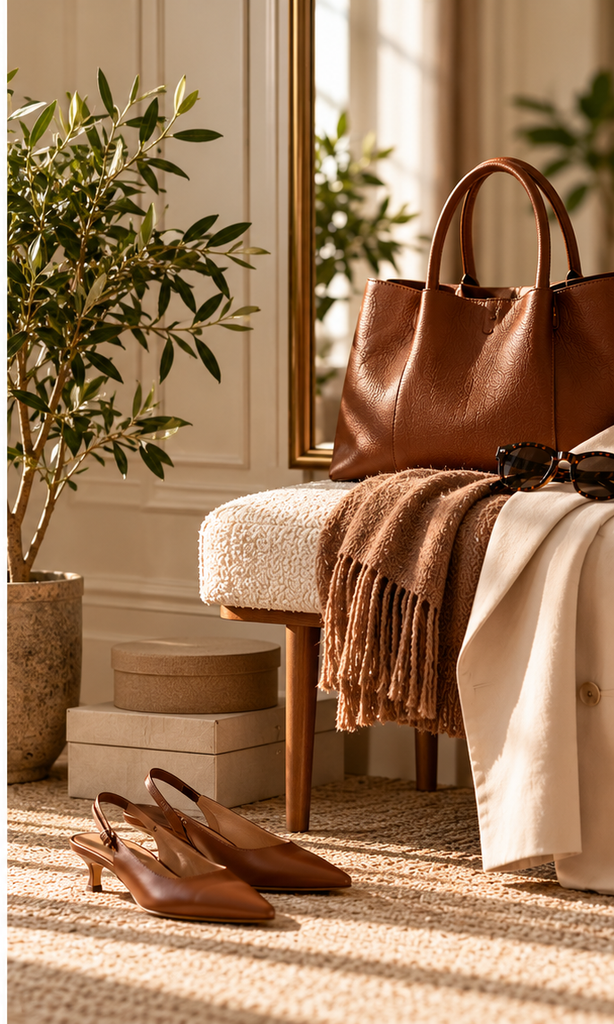
- Using the good things.
- Wearing the beautiful coat regularly rather than saving it.
- Carrying the handbag instead of protecting it for special occasions.
- Using the fine china.
- Opening the beautiful notebook.
- Lighting the candle.
- Wearing the jewellery.
- Reading the books already waiting on the shelf.
There is something quietly luxurious about fully inhabiting the things we have chosen.
Otherwise, we risk becoming custodians of our possessions rather than participants in our own lives.
Perhaps abundance isn’t having more beautiful things; perhaps it’s experiencing more of the beauty already around us.
What Are You Really Looking For?
Sometimes the desire to buy something isn’t really about the object.
- It may be boredom.
- Reward.
- Comfort.
- Identity.
- A desire for change.
- A difficult day.
- A fantasy about becoming someone slightly different.
This doesn’t mean every purchase requires deep psychological analysis; sometimes you simply want a new pair of shoes.
And that is perfectly fine.
But when shopping becomes repetitive or unsatisfying, curiosity can be useful.
Instead of immediately asking, “Should I buy this?”
Try asking, “What am I hoping this will give me?”
The answer can be surprisingly revealing.
Wanting Less Creates Space
When we stop constantly searching for the next thing, we gain something.
- Attention.
- Time.
- Money.
- Physical space.
- Mental space.
But perhaps most importantly, we become more discerning.
The things that do enter our lives have to compete with something far more powerful than another product.
They have to compete with contentment, and that changes the standard.
Instead of asking whether we like something, we begin asking whether we like it enough.
- Enough to spend the money.
- Enough to store it.
- Enough to care for it.
- Enough to choose it over the things we already own.
- Enough to make space for it in our lives.
That is a much higher threshold.
Wanting Less Doesn’t Mean Caring Less
There is a misconception that consuming less requires becoming indifferent to beautiful things.
I think the opposite can be true. The more selective we become, the more attention we can give to what we choose.
- We can care about fabric.
- Craftsmanship.
- Design.
- Provenance.
- Longevity.
- We can wait.
- We can save.
- We can buy something exceptional rather than several things that are merely acceptable.
- We can buy second-hand.
- We can repair.
- We can decide not to buy at all.
Intentional consumption isn’t about removing pleasure; it’s about making pleasure less disposable.
The Freedom of Enough
There is freedom in recognising that something can be beautiful without needing it to become yours.
- There is freedom in walking away from a sale.
- There is freedom in not knowing what the latest must-have item is.
- There is freedom in wearing the same favourite clothes repeatedly.
- There is freedom in discovering that your home doesn’t need another decorative object.
- There is freedom in no longer treating every empty space as something that needs filling.
- And there is freedom in knowing that you can always choose something later.
Enough isn’t a permanent declaration; it is simply the ability to look at your life today and say, “Nothing is missing.”
From that place, we can still buy.
- We can still enjoy fashion.
- We can still collect beautiful things.
- We can still change our minds.
But the relationship changes.
Instead of buying from a sense of lack, we begin choosing from a sense of sufficiency, and perhaps that is where intentional living really begins.
Once we stop asking what else we can add, we are left with a much more interesting question, “What deserves a place in my life?”
That is the work of a curator.
Beauty does not always require possession.