
The Art of Noticing: Why Personal Style Begins With Paying Attention
We are surrounded by inspiration.
We scroll through beautifully styled outfits, save interiors we love, notice women whose style seems effortless and collect images of places we would like to visit. We bookmark, screenshot and pin.
And yet, with so much inspiration available to us, it can sometimes become harder, not easier, to understand what we actually like.
Perhaps the answer isn’t to look for more inspiration; perhaps it is to start paying attention.
Personal style doesn’t begin with knowing what is fashionable. It doesn’t begin with buying the right clothes or finding the perfect wardrobe formula.
It begins with noticing.
- Noticing what repeatedly catches your eye.
- Noticing what you reach for without thinking.
- Noticing the colours that make you feel good.
- Noticing the rooms you want to linger in.
- Noticing the objects you find beautiful.
- Noticing what feels like you, and what doesn’t.
Our preferences leave clues.
The question is whether we are paying enough attention to see them.
Your Style May Already Be There
We often talk about “finding” our personal style as though it is something hidden somewhere outside ourselves.
- We search Pinterest.
- We follow stylish women.
- We read magazines.
- We watch trends come and go.
- We look for someone who can show us what our style is supposed to be.
But perhaps personal style isn’t something we need to find; perhaps it is something we need to notice.
Look at the clothes you have worn repeatedly for years, the photographs you save, your favourite room in your home.
Think about the hotel you still remember, the restaurant whose interior you loved, the painting you couldn’t stop looking at in a gallery, and the clothes you feel most ‘yourself’ wearing.
There will often be threads connecting them.
Perhaps you are repeatedly drawn to simplicity.
Perhaps it is rich colour, beautiful texture, clean lines or soft femininity.
Perhaps you love old things mixed with new.
Perhaps you are drawn to spaces that feel calm and uncluttered, yet your wardrobe is full of clothes competing for attention.
Perhaps your home is warm, considered and quietly elegant, but your wardrobe doesn’t yet speak the same language.
These contradictions are interesting; they tell us something.
Inspiration Versus Imitation
There is nothing wrong with being inspired by other people.
In fact, developing an eye for style often begins by observing what other people do well.
But, inspiration becomes less useful when it turns into imitation.
- We see an outfit we love and immediately want the blazer.
- We see a beautifully styled room and start searching for the lamp.
- We see someone carrying a particular handbag and suddenly wonder whether we need it too.
There is an important question between admiration and acquisition, “What exactly do I like about this?“
- Perhaps it isn’t the blazer; perhaps you like the proportion of an oversized jacket worn with slim trousers.
- Perhaps it isn’t the lamp; perhaps you’re responding to the warmth of the lighting.
- Perhaps it isn’t the handbag; perhaps you love the simplicity of the entire outfit.
When we learn to identify why something appeals to us, inspiration becomes information.
And that information helps us understand our own taste.
Pay Attention to Repetition
One of the simplest ways to understand your style is to look for repetition.
We often dismiss the things we repeatedly choose because they feel too obvious.
- The same trousers.
- The same neckline.
- The same neutral colours.
- The same jewellery.
- The same silhouette.
But repetition isn’t necessarily evidence that we are unimaginative.
It can be evidence that something works.
I have come to recognise certain formulas within my own wardrobe. Wide-leg trousers, for example, appear again and again. Navy and brown have become valuable alternatives to black. Certain proportions simply feel more like me than others.
Rather than fighting those patterns in the name of variety, I have learned to pay attention to them.
They are clues.
Personal style isn’t about wearing something different every day.
It is about understanding the elements you return to, and becoming increasingly intentional about them.
Your Taste Exists Beyond Your Wardrobe
This is where the idea of personal style becomes much more interesting.
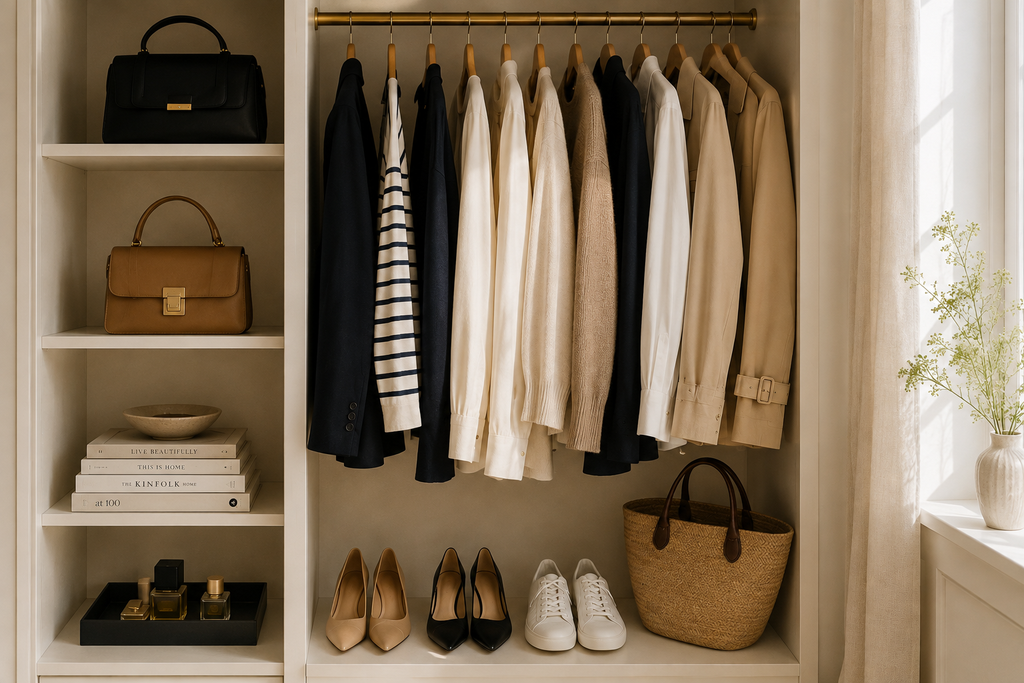
Style doesn’t stop at the wardrobe door.
The same eye that chooses a coat, chooses a chair.
The same person who responds to a particular colour palette in clothing may find herself drawn to it in interiors.
The qualities you appreciate in fashion – simplicity, craftsmanship, history, modernity, softness, structure, restraint, eccentricity – may appear throughout your life.
Look around your home.- Look at your books.
- Look at the art you love.
- Think about your favourite places.
- Consider the objects you have kept for years.
What do they have in common?
Some may be expensive. Others may have cost almost nothing.
Some may be pristine. Others may be worn with age.
But chances are, the things you truly love say something about you.
Style is not simply an aesthetic exercise.
It is a form of recognition.
Stop Asking, “Is This Stylish?“
One of the most freeing questions we can stop asking is, “Is this stylish?“
Almost anything can be stylish in the right context.
A better question is, “Do I like it?“
And then, “Why?“
These questions sound ridiculously simple, but they aren’t.
It takes confidence to have preferences, particularly when those preferences don’t align with what everyone else seems to be buying, wearing or admiring.
- You might not like the colour of the season.
- You might not want the handbag everyone else wants.
- You might prefer an old piece of furniture to something new.
- You might love a ten-year-old pair of jeans more than anything currently hanging in the shops.
Good. That is where things start getting interesting.
Because taste develops when we stop automatically accepting other people’s definitions of what is desirable.
Create Space to Notice
Noticing requires a little quiet.
It is difficult to hear your own preferences when you are constantly being shown someone else’s.
That doesn’t mean abandoning social media, magazines or Pinterest. Inspiration can be wonderful, but sometimes we need to move from consuming to observing.
Instead of scrolling through another hundred outfits, look at the twenty you already saved.
- What appears repeatedly?
Instead of adding another hundred pieces to a Pinterest board, study what is already there.
- What colours dominate?
- What silhouettes?
- What mood?
- What details?
And perhaps most importantly, “Would I actually want this in my life, or do I simply enjoy looking at it?“
There is an enormous difference.
We can appreciate something without needing to become it.
We can admire someone else’s style without making it our own.
We can find an object beautiful without needing to possess it.
That distinction is at the heart of intentional living.
Developing Your Eye
Taste isn’t fixed.
It develops.
The more attention we pay, the more discerning we become.
We begin to recognise quality.
We notice proportion.
We understand why one combination feels harmonious and another doesn’t.
We become more comfortable with restraint.
And gradually, we stop needing quite so much external validation.
This doesn’t happen overnight.
It happens through looking, trying, wearing, living.
It happens through getting things wrong, changing our minds, and noticing again.
Over time, we build a visual vocabulary of our own.
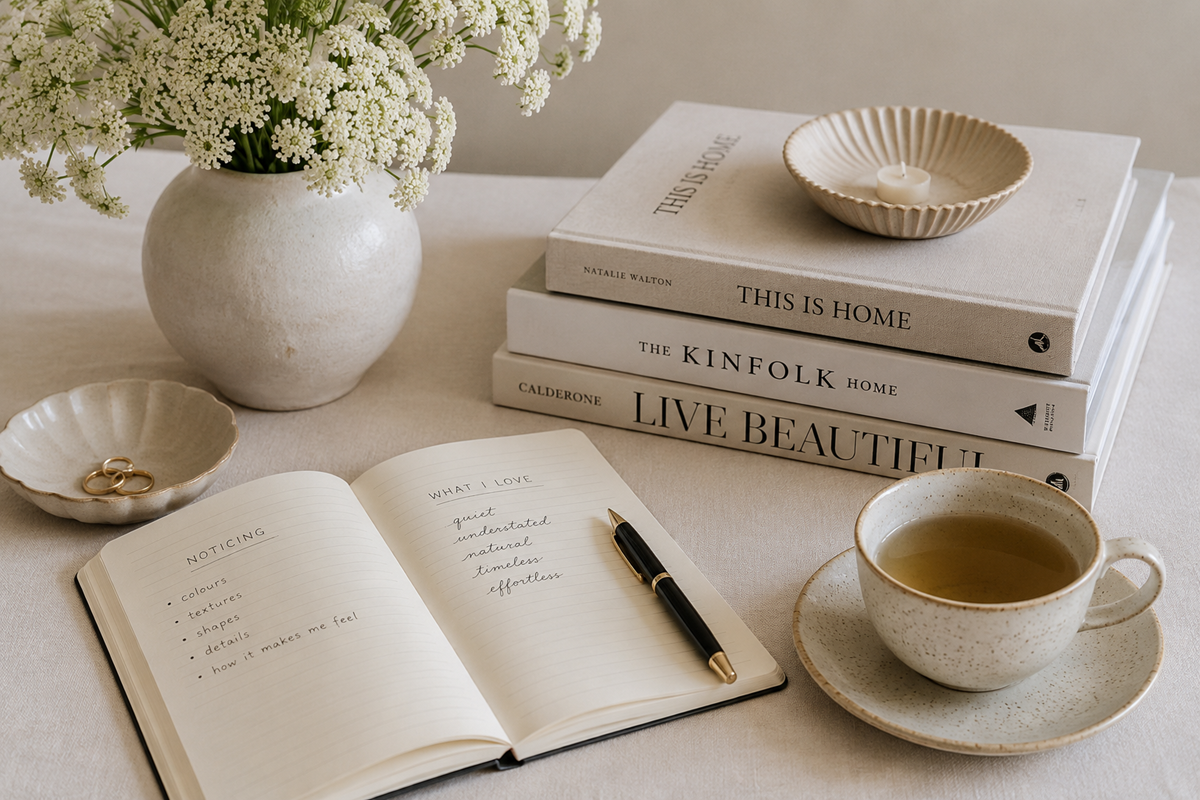
A Small Exercise in Noticing
Over the next week, don’t try to change anything.
Simply pay attention.
- Notice the outfit you feel particularly good wearing.
- Notice something in your home that gives you pleasure every time you see it.
- Notice a colour combination that catches your eye.
- Notice the photograph you stop scrolling for.
- Notice the café, garden, building or room that makes you want to stay.
- Notice the piece of clothing you instinctively reach for.
Then ask yourself, “What is it about this that I love?“
Don’t worry about whether the answer sounds sophisticated.
- “It feels calm” is enough.
- “It looks expensive” is interesting.
- “I love the colour” is useful.
- “It reminds me of Paris” tells you something.
- “I feel like myself in it” tells you even more.
Write these observations down.
You may begin to see patterns.
Style Begins With Attention
There is a temptation, whenever we want to change something about ourselves or our lives, to begin by adding.
- More clothes.
- More inspiration.
- More advice.
- More things.
But sometimes the first step isn’t adding anything.
It is noticing what is already there.
- Your preferences.
- Your patterns.
- Your instincts.
- Your surroundings.
- The things you have loved for years.
- The things you never tire of.
These are the raw materials of personal style.
And once you begin paying attention to them, something shifts.
You stop asking quite so often what you should like, and you become more curious about what you actually like.
That is where personal style becomes personal.
And it is also where intentional living begins.
Before you can refine your style, you have to notice what you love.
Intentional living is the art of making our own choices before others’ choices make us.
Richie Norton
You Might Also Like
Simplicity Is A Style Strategy, Not A Limitation
Dress with Intention: Creating Your Future Self Through Style
How to Stop Impulse Buying and Start Buying With Intention
Why Buying Second-Hand Clothes Is a Smart, Sustainable Choice